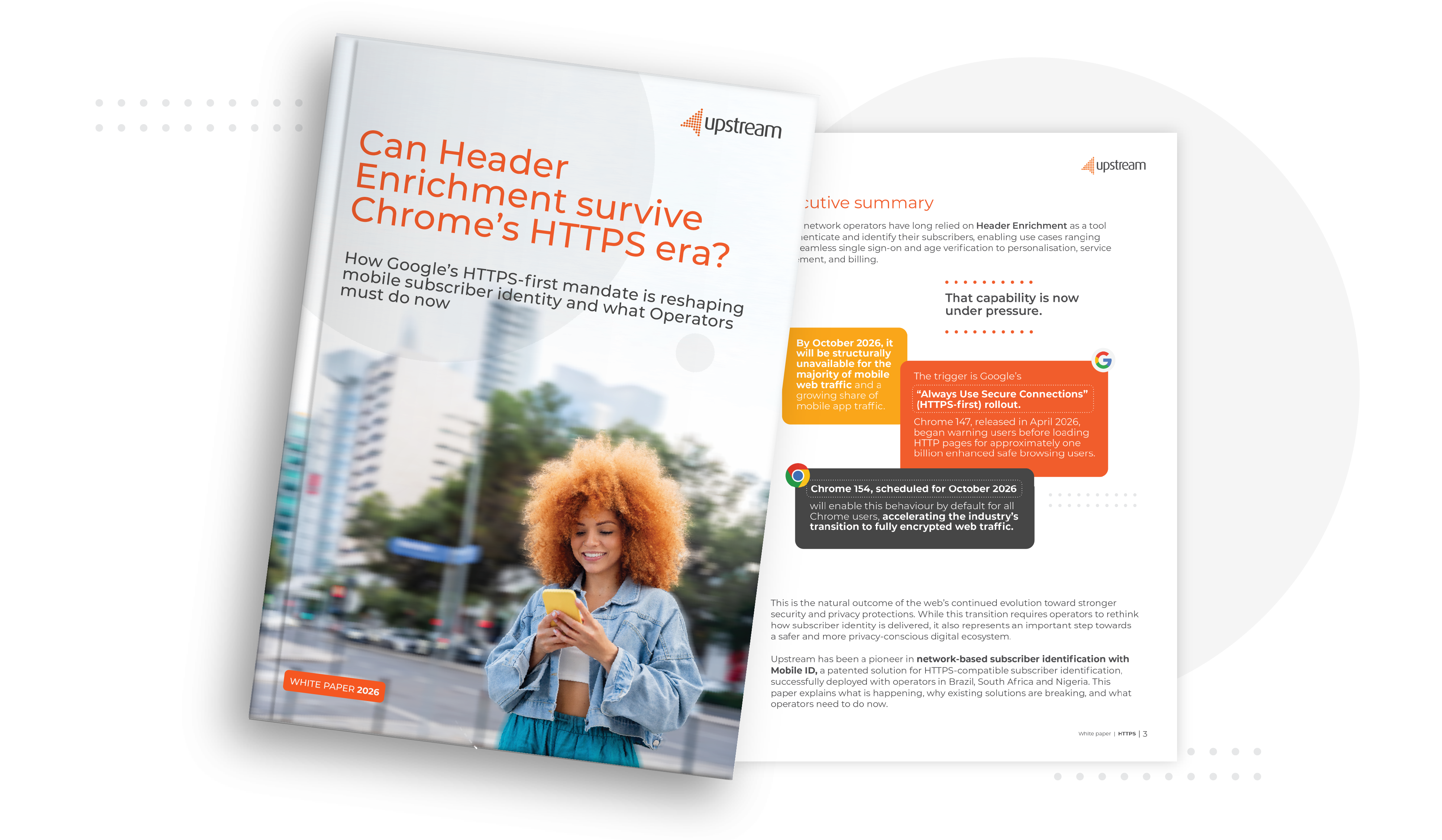
With Google Chrome set to enforce HTTPS-first browsing for all users by October 2026, Upstream offers proven solutions that enable mobile operators to maintain subscriber identification capabilities.
ATHENS, GREECE – July 30, 2026 – Upstream, a leading mobile technology company headquartered in Greece with a presence in more than 45 markets across four continents, highlights the significant changes taking shape in the mobile telecommunications ecosystem, as the web moves toward a fully encrypted, more secure environment.
In light of these developments, Upstream has recently published a new white paper titled “Can Header Enrichment Survive Chrome’s HTTPS Era?”, in which it analyzes how Chrome’s HTTPS-only enforcement reshapes the way mobile subscribers are identified and, at the same time, presents an innovative, deployment-ready solution.
What’s Changing and Why It Matters
For years, mobile network operators have relied on Header Enrichment, a capability that enables automatic subscriber identification when users connect to services via a mobile network – without requiring a password – to provide critical features such as seamless login (logging in without additional authentication steps), age verification, service activation, and the overall personalization of the user experience. This technology forms the foundation for a seamless experience that reduces barriers to accessing digital services for users and, at the same time, accounts for a significant share of mobile operators’ digital revenue.
Chrome, the browser that accounts for over 75% of global internet traffic, is progressively rolling out its “Always Use Secure Connections” policy, requiring full encryption (HTTPS) for all connections by October 2026. This will bring an end to traditional Header Enrichment as operators have used it to date. And while the transition to a more secure internet browsing environment is undoubtedly a positive development, it simultaneously creates new requirements for mobile operators, who are called upon to maintain secure and reliable subscriber authentication in a fully encrypted environment.
The impact is already becoming visible! Following the release of Chrome 147 in April 2026, Upstream has recorded a 23% drop in the enriched traffic used to identify subscribers.
A pioneer in mobile technology for two decades
Operating in one of the most demanding ecosystems worldwide, that of telecommunications services (high transaction volumes, heterogeneous network infrastructures, strict compliance requirements), Upstream’s team of engineers has developed deep expertise that enables it to find solutions even in environments characterized by significant external pressures (such as those imposed by the need to adapt to Chrome’s new protocol) as well as rapid technological acceleration.
This expertise led to the development of Mobile ID, a patented solution that allows mobile operators to continue identifying their subscribers Chrome’s new HTTPS-only era. Upstream’s engineering team identified and implemented targeted enhancements that fully restore Mobile ID’s functionality under the new, security-enhanced protocol that Chrome has already begun enforcing. The solution is already live and operational with providers in Brazil, South Africa, and Nigeria and can be deployed ahead of Google’s October deadline.
Dimitris Maniatis, CEO of Upstream, stated: “The transition to a more secure internet is a significant step for the entire digital ecosystem. For mobile operators, in particular, this means they must reevaluate how they manage subscriber identification in order to continue offering them seamless and personalized experiences. At Upstream, we have always anticipated the technological shifts shaping our industry and developed solutions that help mobile operators not only adapt to this new reality, but turn it into a strategic advantage.”
The white paper “Can Header Enrichment Survive Chrome’s HTTPS Era?” is available here.